From Cal Whitmore's videosBefore You Dig: The Farm Pond Decision Book

Before you dig.

The farm pond decision book. Site, soil, watershed, dam, spillway, permit, and bid. Settled before the first bucket.

Buy the PDF, $24.95

30-day refund. If the book does not earn its keep before the first bucket, reply and we refund it.

PDF. Instant download. Print the worksheets today.

  • You own land. You are about to hire an excavator for a farm pond or a fishing pond.
  • You have not broken ground. The site, the soil, the dam, the spillway, the permit, and the bid are still open.
  • This is not a backyard water garden. This is not a koi pond.
Cal Whitmore
Before You Dig: The Farm Pond Decision Book

What the wrong pond costs.

Figures from dated pages cited in the book. Not an estimate of what you will save: what the source says the wrong hole costs.

The national guides put a farm pond at $3,000 to $23,000, and that is the whole check you lose the use of if the basin will not hold water. HomeGuide, How Much Does It Cost to Build a Pond?, page dated January 5, 2026, as of January 2026 $3,000 to $23,000
The geotechnical soil report that tells you whether the ground will hold is listed at $1,000 to $5,000, against a pond listed at $3,000 to $23,000. HomeGuide, accessed 2026-09-13 $1,000 to $5,000
Ask the Corps district before the machine comes, because a violation of a permit condition carries a civil penalty of up to $25,000 per day for each violation. 33 U.S.C. 1344(s)(4), accessed 2026-09-13 $25,000 per day

These are national guide bands and a federal statute, not a quote for your ground. Verify the permit question with your county, your conservation district, and your Corps district office, and every dollar on two written bids for the same scope. When a source turns out wrong, the correction goes on the corrections page.

Buy the PDF, $24.95

30-day refund. If the book does not earn its keep before the first bucket, reply and we refund it.

What's inside

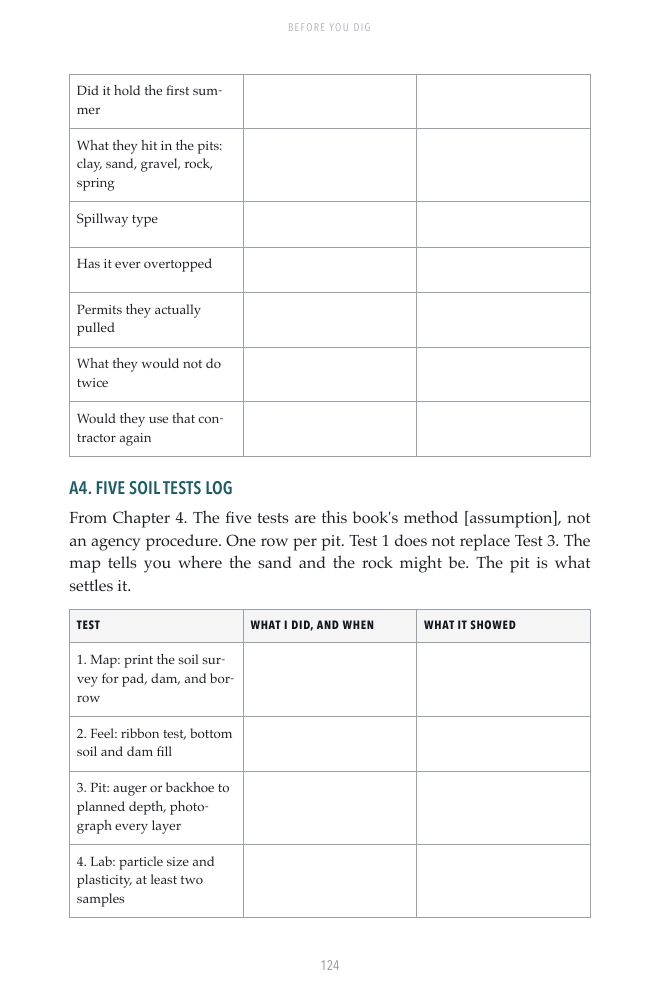
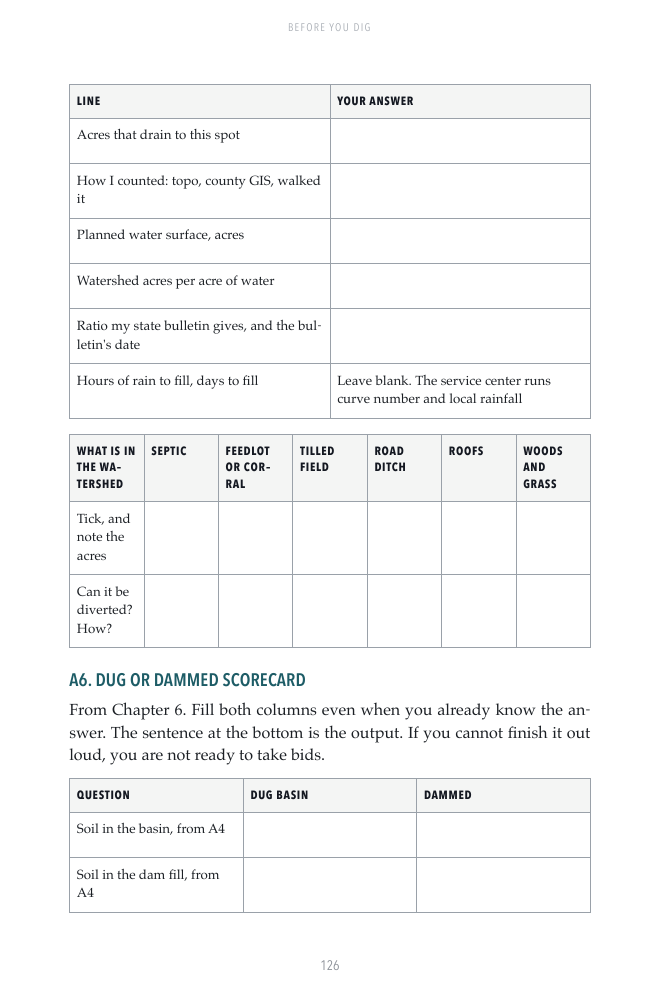
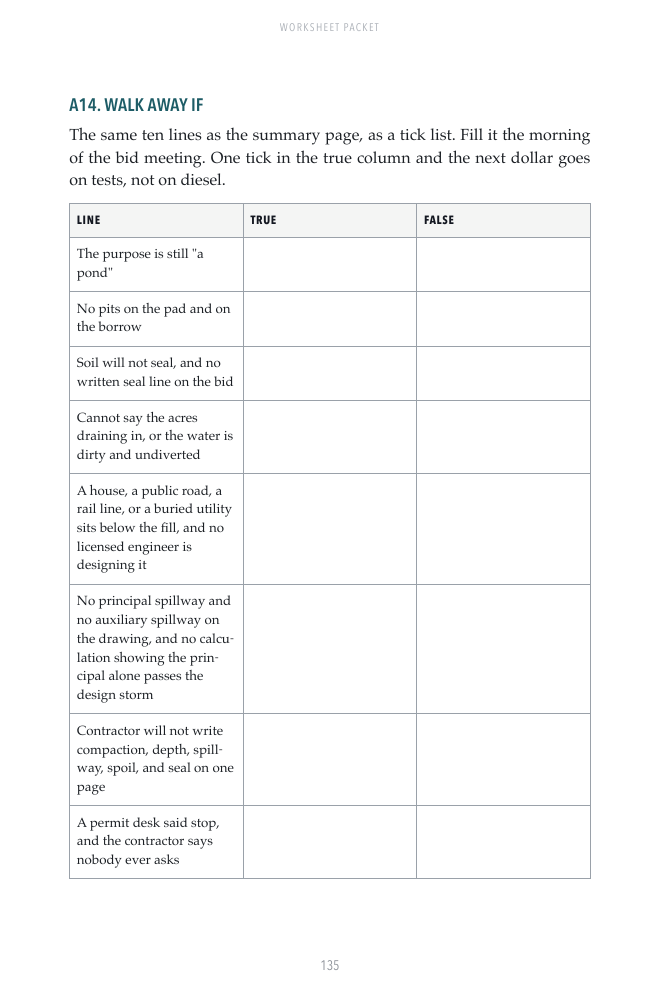
Real pages from the book. Tap one to read it full size.

  • 1. Soil tests What to order before you call an excavator. How to read the sheet. When the soil says do not dig here.
  • 2. Watershed math How many acres feed a one-acre pond. How to count the ground that actually drains to your site.
  • 3. Dug pond or dammed pond Which one your ground can support. What fails on a slope. What fails in a hole that never sees enough water.
  • 4. Depth Why a shallow pond turns green. How deep the deep end needs to be for the job you named (fishing, livestock, or swimming).
  • 5. Dam and spillway The failure that floods the neighbor. What a spillway is for. What to refuse if the bid has no spillway line.
  • 6. Permits (NRCS, state, wetlands) When you need a permit. Who to call. This book does not replace the permit.
  • 7. Reading an excavator bid What each line means. What a cheap bid left out. What to ask before you sign.
  • 8. Liner, clay, or bentonite When native clay is enough. When bentonite is the honest fix. When a liner is the only option left. When to walk away instead.

160 pages, thirteen chapters, fourteen worksheets, one walk-away page. 160 pages, thirteen chapters in six parts, fourteen printable worksheets in Appendix A, and the one-page "Walk away if" sheet you carry to the site.

See all 13 chapters and the fourteen worksheets

Decide the use

The purpose and the evidence before the hole.

  • 1. The hole you cannot undo What you are actually buying, and the four things that should already be paid for before an excavator is on your calendar.
  • 2. Fishing, livestock, or swimming The purpose worksheet, and why the second use is only allowed when it does not wreck the first.
  • 3. What to ask the neighbor whose pond works The interview card. A pond that held next door is evidence. Guessing is not.

Read the ground

What the soil and the acres decide.

  • 4. Five soil tests before you call an excavator Map, feel, pit, lab, hold. What each one shows, and what a sand seam in a pit wall means for the whole job.
  • 5. Watershed math How to trace the ground that drains to your site, count the acres, and spot the drainage you must not let in.
  • 6. Dug or dammed on your ground A site decision, not a taste decision, with the scorecard that forces the sentence.

Size and engineer

The numbers that make the dam hold.

  • 7. The depth rule, and why shallow ponds turn green Deep end, shelf, and the bid that prices acres of water with no depth spec.
  • 8. Dam and spillway The failure that reaches your neighbor. The principal and emergency pair that must both be on the drawing, and the dam red flags you can see from the truck.

Seal and leaks

Why water gets away, and how to stop it.

  • 9. Why ponds leak: four causes Which ones you can buy your way out of before you dig, and which one means this is the wrong site.
  • 10. Liner, native clay, or bentonite Three paths, priced as their own line on the bid instead of as a surprise in August.

Permits and bids

The desks and the paperwork before you sign.

  • 11. When you need a permit County, conservation district, state dam safety, state water, wetlands. The phone script and the log. The book is the call list, not the permit.
  • 12. Reading an excavator bid Two bids on one sheet, line by line. If a line is missing, it is not included.

Dirt and cleanup

Where the dirt goes, and who it is free for.

  • 13. Spoil: the "free" pond Where every yard goes, and the three questions that tell you whether a free pond is your pond.

The fourteen worksheets

  • A1. What I think I am buying
  • A2. Purpose: fishing, livestock, or swimming
  • A3. Neighbor interview card
  • A4. Five soil tests log
  • A5. Watershed acres
  • A6. Dug or dammed scorecard
  • A7. Depth and shelf
  • A8. Downstream and spillway red flags
  • A9. Four leak causes, before you dig
  • A10. Liner, clay, or bentonite
  • A11. Permit phone log
  • A12. Bid comparison
  • A13. Spoil plan
  • A14. Walk away if

What you get for $24.95.

Before You Dig: The Farm Pond Decision Book

160-page PDF, 13 chapters, every figure with its sheet and date, or labelled as an assumption.

Fourteen printable worksheets

Appendix A, one per chapter, blank and ready to fill.

The "Walk away if" sheet

One page, also its own chapter, built to carry to the site.

Public errata for this edition

Posted at FarmPondBook.com/errata when a figure changes.

Buy the PDF, $24.95

30-day refund. If the book does not earn its keep before the first bucket, reply and we refund it.

Secure checkout by Stripe. The payment page shows Readstall, our imprint.

FAQ

Why not let the excavator decide?

The excavator is paid to move dirt. He is not paid to pick the site, read your soil, size the spillway, or pull the permit. This book is the work you do before he starts the truck.

Is this a real book or only a file?

The pages shown here are pages of the book itself. There is no paperback, only the PDF. Buy it, print the worksheets the same day.

Does this replace a permit, NRCS, or an engineer?

No. If your county, your state, or NRCS requires a permit or a stamped plan, you still get that. The book tells you what to ask and when you likely need them.

I want a small garden pond with a pump and a liner kit. Is this for me?

No. This is a farm pond or a fishing pond on land you already own. Water gardens and koi ponds are a different job.

What does a pond like this cost?

Published cost guides put a farm pond at $3,000 to $23,000, and a fishing pond as high as $52,500. Your bid will differ. Soil, access, and county rules move the number. Get local bids. Verify before you sign.

The PDF opens on the next page. We may write when there is a correction or a new book; every email has a one-click way to stop.