Will Your Soil Hold a Pond? 5 Tests Before You Call an Excavator
 From Cal Whitmore's video19 September 2026
The excavator can be here in three weeks, but nobody has seen what is three feet under the grass. These are the five soil tests to run first, cheapest first, and the one-word call they add up to: dig, seal, line, or walk away.
A pond is dirt that has been moved, and dirt does not go back. USDA's Agriculture Handbook 590, revised November 1997, is blunt about whose fault the dry ones are: "Selecting a poor site is often the result of inadequate site investigations and could have been avoided."
National guides put a farm pond at $3,000 to $23,000 (HomeGuide, page dated January 5, 2026). Against a band like that, a soil report at $1,000 to $5,000 is cheap insurance.
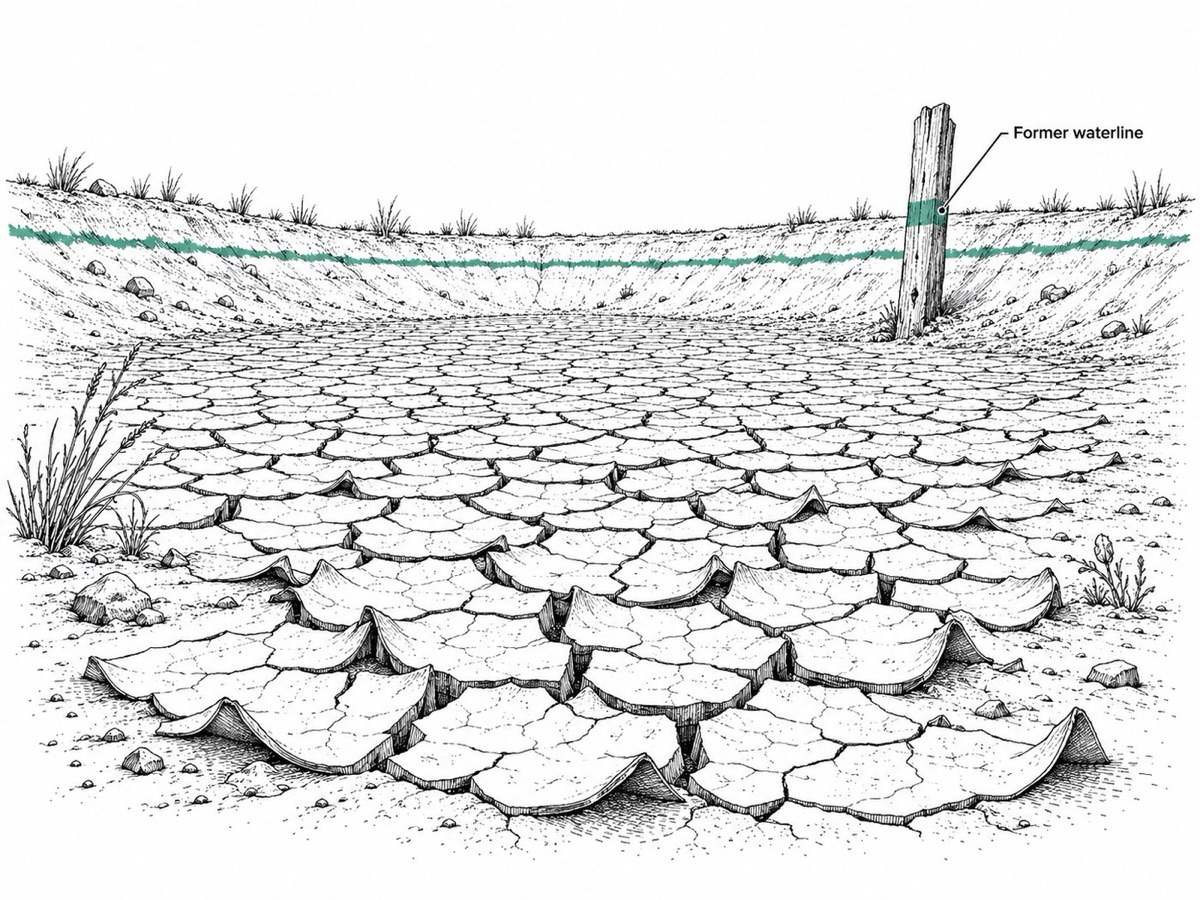
Each test fills one row of a sheet whose last column takes one word. Map, feel, pit, lab, hold is the book's own sequence, an assumption in print, not a USDA procedure.
Test 1. Map
Print the Web Soil Survey map for your area of interest and mark three things separately: the pond pad, the dam centerline, the borrow.
Web Soil Survey covers more than 95 percent of US counties and calls itself the single authoritative source of soil survey information. The same page says onsite investigation is needed for certain engineering applications. A dam is one. The map is saying, in its own words, that it does not finish this job.
Circle every unit that names sand, gravel, or shallow bedrock, because a Texas extension bulletin warns that one thin lens of either causes serious seepage even where overall permeability is low. Mark the three areas in three colors. They are three soils until somebody proves otherwise.
The map finds candidates. It does not clear a site.
Test 2. Feel
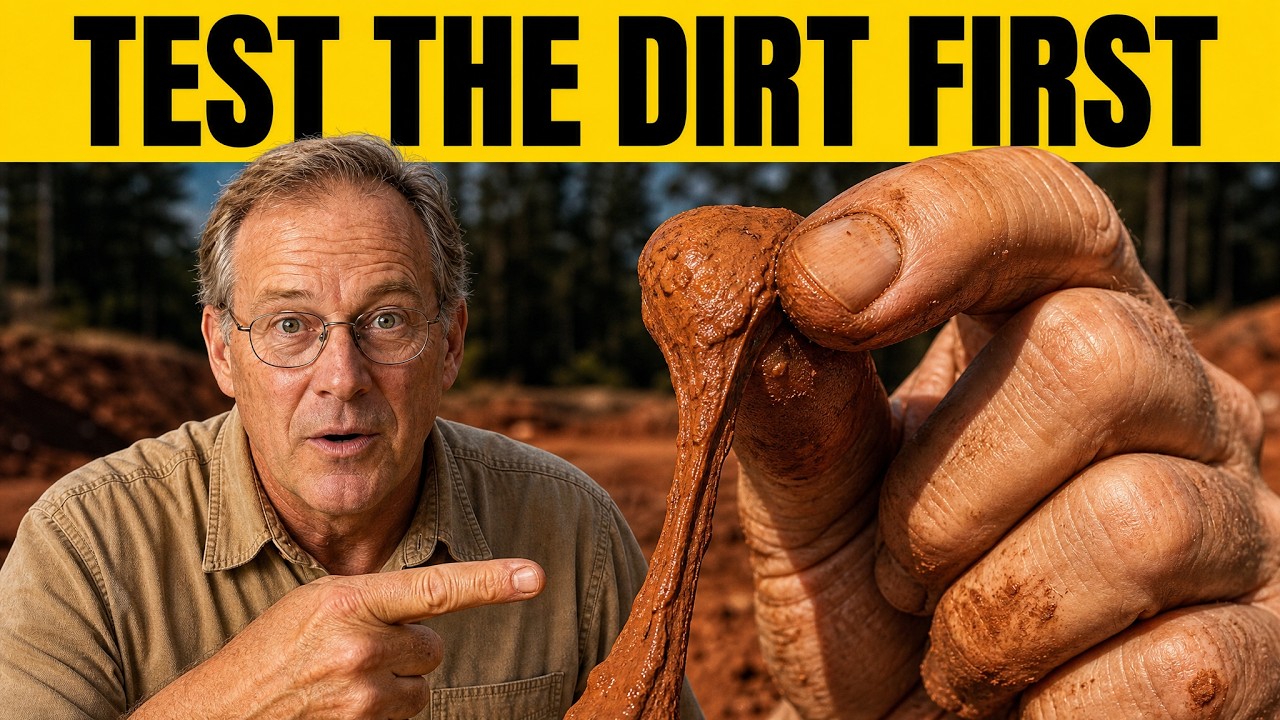
Take a handful from the planned bottom and one from the dam borrow, wet it to putty, and ribbon it between thumb and forefinger.
Ribbon length before it breaks, per Colorado State Extension, GardenNotes 214, reviewed September 2022:
- Under 1 inch: the loam group
- 1 to 2 inches: clay loam
- 2 inches or more: the clay group
- Will not ball at all: sand
Write the length down and where it came from. Be careful: this is the test that fools people who have farmed the ground forty years. University of Missouri Extension publication G1555 warns that bright red subsoils high in clay will ribbon and feel like suitable building material, and often do not hold water, because the clay particles cluster and behave like sand.
I would still run it. Not to decide anything, to aim: the ribbon tells you where the lab money should go. The feel test names a texture class. It does not certify a reservoir.
Test 3. Pit
First the safety line, and it is federal. Nobody enters a pit without a protective system: sloping, benching, shoring, or a trench box, under 29 CFR 1926.652(a)(1). Read the wall from the surface, machine shut down.
Open pits or borings to your planned depth, photograph every layer with a rule in the frame, and log the layers and where water stands.
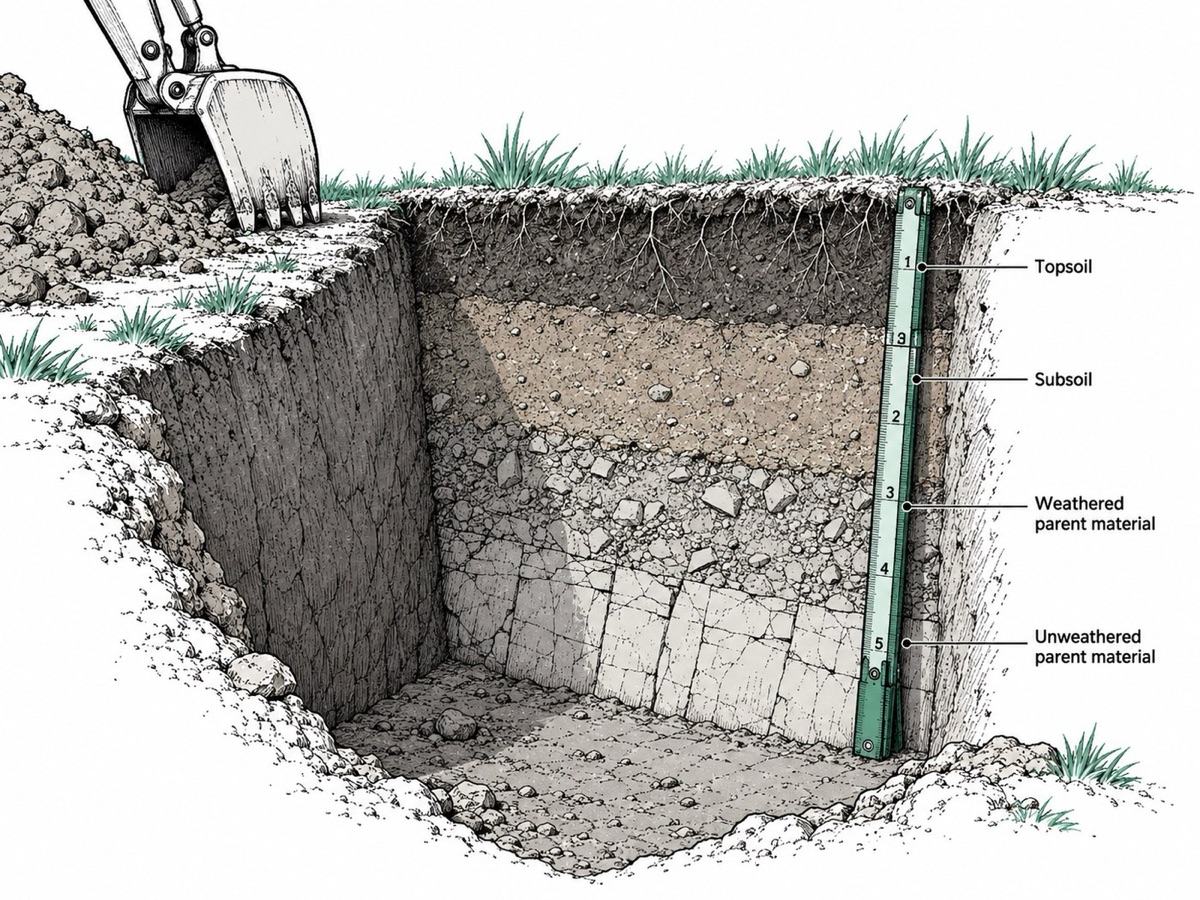
How many? AH 590: "Three or four borings per acre may be enough if the soils are uniform. More may be required if there are significant differences." NRCS Practice Standard 378, July 2022, names places instead:
- The embankment foundation
- The auxiliary spillway
- The borrow
Under the dam it is depth. Foundation holes go one and a half times the planned dam height.
The book's working line is printed as an assumption: enough pits that a sand seam cannot hide. If two pits disagree, you do not have enough pits.
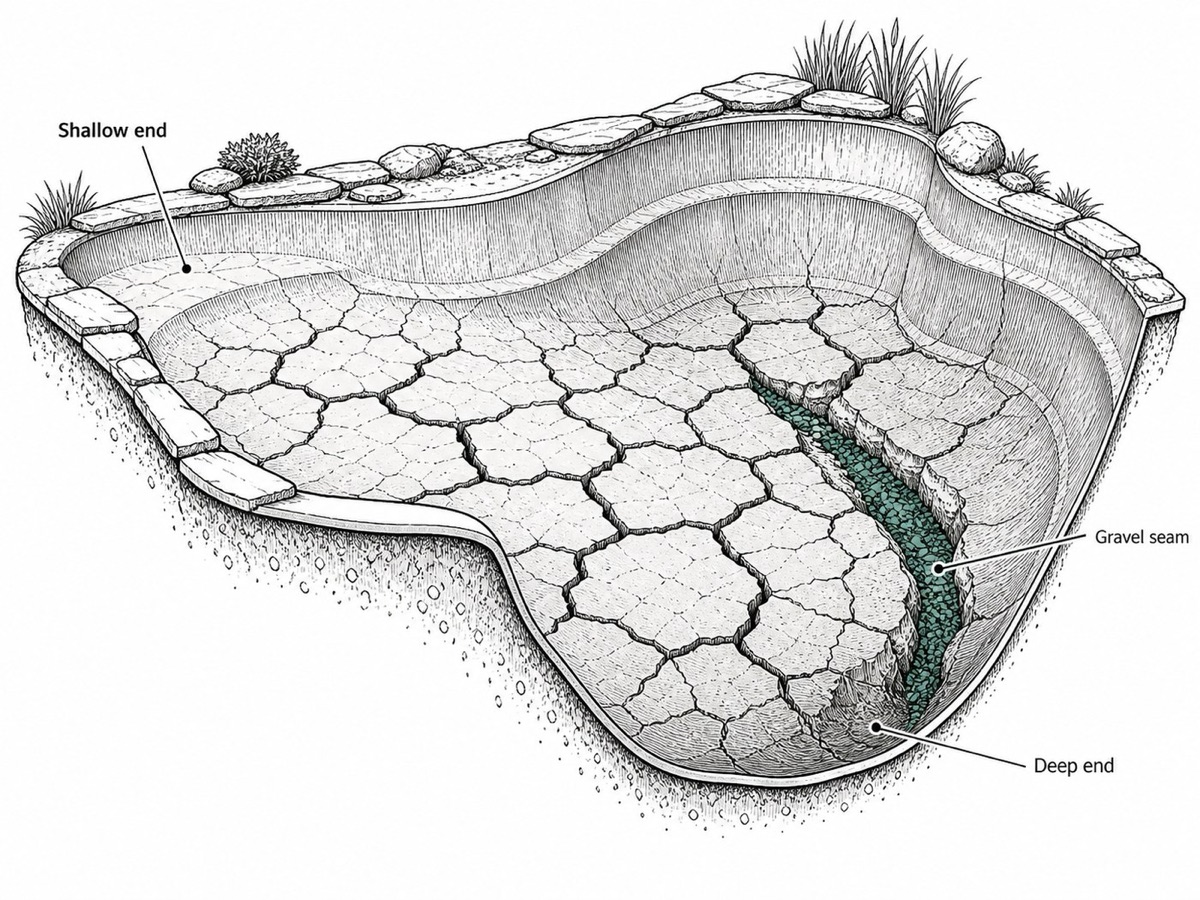
This is the test people skip, and it is the one that finds the seam that empties an acre. Picture orange clay, and a band of clean grey sand four feet down, six inches thick, the width of your palm. Half a day of machine time finds it, and nothing else on this list would.
Test 4. Lab
Send two samples at minimum, pond bottom and dam borrow, and name particle size, Atterberg limits, and an ASTM D2487 classification on the order.
The lab sheet gets measured against AH 590, which says soils with "at least 20 percent passing the No. 200 sieve, a Plasticity Index of more than 10 percent, and an undisturbed thickness of at least 3 feet do not have excessive seepage when the water depth is less than 10 feet."
Four conditions, all at once, and the last is a depth limit on the whole rule. A sheet that only answers the first one is not a finished sheet. Two traps:
- Twenty percent passing the No. 200 sieve is not twenty percent clay. That sieve catches fines, silt plus clay, so a silt with almost no clay passes the first condition and leaks. That is why the plasticity index is in the same sentence.
- AH 590 wants embankment earthfill at about 20 percent clay particles by weight. That number is clay, and it is about the dam, not the basin.
Test 5. Hold
Fill a test pit with water and record start level, end level, hours elapsed, and the weather on the day.
AH 590 puts it plainly: "You can get some indication of permeability by filling the test holes with water. The seepage indicates what to expect of a pond excavated in the same kind of material."
Notice what is missing. No hours. No inches per hour. No pass mark. There is no national number, and none is invented here. The hours you pick are an assumption unless your state bulletin sets them.
Test five is a fifth opinion. It agrees with your lab sheet, or it sends you back for another pit.
Dig, seal, line, or walk away
Five rows, then one word in the call column.
- Dig: all four conditions are met and the pits agree.
- Seal: part of it does not hold, which sends you to bentonite with a known area instead of a guess.
- Line: the native material will not do it.
- Walk away: making this site hold water costs a second pond.
Two calls belong on that table first. Your conservation district or NRCS field office, answer written down. And if a home, a road, or a utility sits downhill of the dam line, AH 590 sends you to a licensed engineer and your state dam safety office. Then 811.
One word in the last column books the machine. Not the three week opening.